★
Serving Dallas Fort Worth, Texas
★
RedLine Welding Services
Structural steel for buildings, mezzanines, stairs and handrails — welded to code and built to carry the load.
Structural work leaves no room for guesswork. We weld beams, columns and connections to specification, and we are happy to work alongside your engineer and inspector.
From a single mezzanine to a full building frame, we keep the job moving and the paperwork straight.
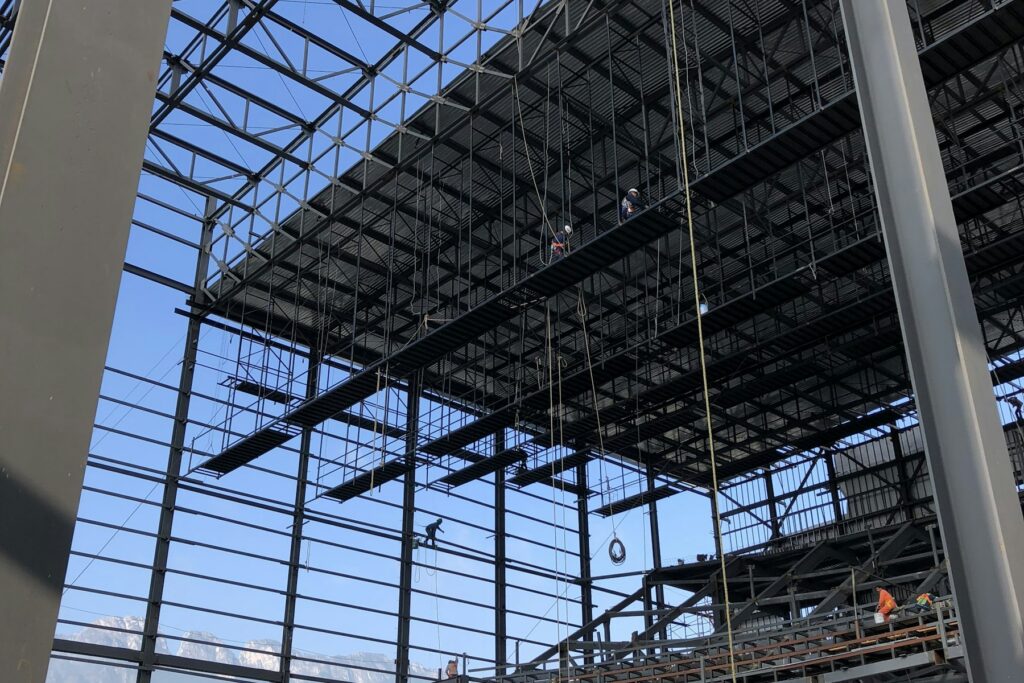
Structural work is not harder to weld than anything else on this site. What makes it different is the consequence of getting it wrong. A bracket that fails drops a sign; a column or a beam that fails takes part of a building with it. So the standards, the paperwork and the sequence are all tighter — and the person who decides what size a member should be is a licensed structural engineer, not a fabricator and not a contractor.
The normal sequence is straightforward: an engineer specifies the member, the connections and the weld requirements; a permit is obtained where one is required; the steel is fabricated and welded to that specification; and the work is inspected. Our job is to build exactly what was specified and to be able to show that we did.
That is also why we will turn work away. If someone offers to size a structural beam for you without an engineer’s drawing, that is the signal to stop — whoever they are. Where a job needs welding to a published code or an inspected procedure, that gets confirmed in writing before anything is cut. [VERIFY — confirm which code-governed structural work this business undertakes, and under what certification, before relying on this page for a specific project.]
How a structural job runs
Engineer’s drawing defines the member, the connections and the weld requirements. Permit where required.
Correct grade and section, cut to size, edges prepared and joints fitted to the specified tolerance.
Specified process and filler, correct sequence to control distortion, welded to full specified size.
Visual inspection, any specified testing, then priming or protection before the steel is closed in.
We work with contractors, builders and property owners across Dallas, Fort Worth, Arlington, Irving, Grand Prairie, Plano, Frisco, Garland, Richardson, McKinney, Carrollton and the surrounding metroplex.
Bring us in early rather than late. Once drawings exist, the questions that decide cost and programme — section sizes, connection details, access for the steel, whether anything needs to be lifted or fabricated in pieces — can all be settled on paper. There is more on the boundary between fabrication and structural work in our guide to custom metal fabrication in DFW, and pricing is explained in the welding cost guide.
Structural welding applies when the steel carries part of a building — beams, columns, lintels, base plates, or a modification to an existing load path. That always begins with a licensed structural engineer. If your project is a gate, a handrail, a stair or a frame that does not hold a building up, it belongs under fabrication. A breakage that needs fixing where it stands is mobile welding; machines and attachments are equipment repair; and keeping existing steelwork sound is maintenance and repair.
If the steel carries part of a building — a beam, a column, a lintel over an opening, a modification to an existing load path — then yes. Sizing those members is an engineer’s responsibility and a fabricator cannot take it on. For non-load-bearing work such as brackets, guards and equipment supports, no engineer is involved.
Yes — that is the normal way structural work runs. Send the drawings with the quote request. If anything on them is unclear or looks impractical to build or install as drawn, we will raise it with you and your engineer before fabrication rather than improvise on site.
Both happen. Field welding of connections, splices and repairs to existing steel is routine — stick and flux-core are used outdoors for exactly that reason. Larger assemblies are usually better fabricated where there is a flat floor and a bench, then brought in and set. Which route suits your job is part of the quote conversation.
Frequently. Corroded sections can be cut out and replaced, cracked connections rebuilt, and load paths reinforced with plates or added bracing. What that repair may be is an engineering question, not a welding one — the specification comes first, and the repair is built to it.
Usually, for anything load-bearing. Permitting and inspection are run by each city individually across the metroplex, so requirements and thresholds differ between, say, Dallas and Frisco. Your local building inspection department is the authority and should be consulted before work begins.
Mainly by sequence and heat input — welding in a planned order, balancing welds either side of a member, and not putting more heat into the steel than the joint needs. Fit-up matters too: a joint clamped square and tight distorts far less than one pulled together by the weld itself.
Tell us what you need and we will come back with a straight answer and a fair price. Free, fast, no obligation.