★
Serving Dallas Fort Worth, Texas
★
Fabrication
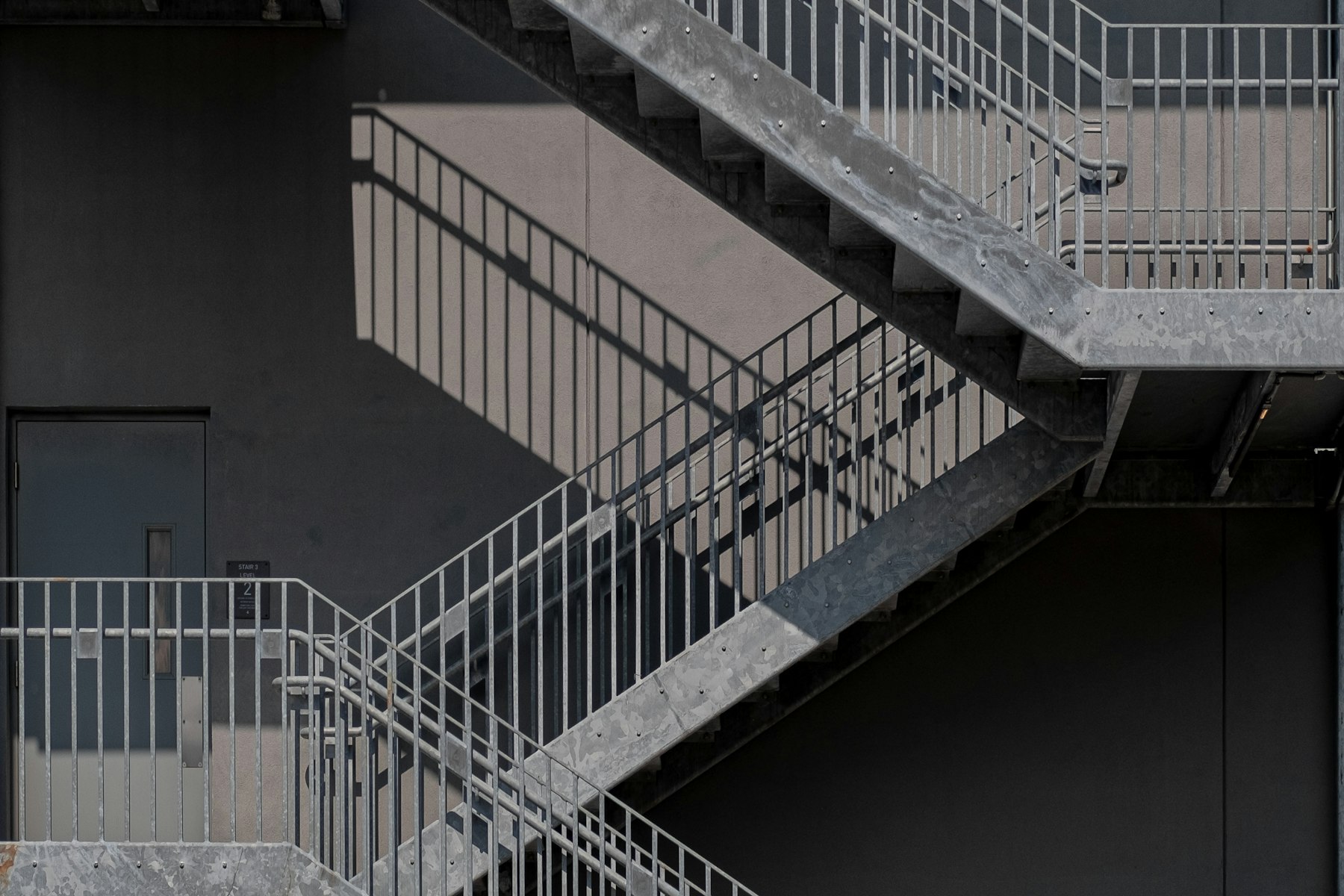
Steel stairs, landings, handrails and guardrails — built to fit the opening you actually have, and to the code your city has adopted.
Stairs and rails are the category where the rules are strictest, and for the obvious reason: these are the things people put their weight on. Stair geometry, rail heights, graspability, the gap a child could pass through and the load a guardrail has to resist are all set by the building code your city has adopted, not by preference.
The other half of the job is fit. Slabs are rarely level, openings are rarely square, and a stair built to a nominal rise will end up with one step out at the top. Measuring the space as it really is — before anything is cut — is what separates a flight that feels solid from one that does not.
Straight, switchback and spiral-access stair flights
Stringers, treads, risers and landings
Handrails, guardrails and grab rails
Mezzanine, platform and catwalk access
Ramps, step units and kerb access
Repairs and extensions to existing stairs and rails
Most of the work happens before the welding — in the measuring and the drawing, where changes are still free.
Four Steps
Site visit: rise and going, floor levels, fixings and what the structure can be fixed to. Nothing assumed square.
A drawing, a material spec and a finish — plus confirming which code requirements apply to your project.
Cut, prepare, fit and weld. Powder coating or galvanising goes off site and adds lead time.
Set fixings, position and align, adjust, and touch up any protection disturbed on site.
We cover Dallas, Fort Worth, Arlington, Irving, Grand Prairie, Plano, Frisco, Garland, Richardson, McKinney, Carrollton and the surrounding metroplex.
Two questions get asked early because they change the design and the price: is this residential or commercial, and will it be inspected. A rail that has to pass inspection is not the same product as one going round a private patio. Full service detail is on the fabrication page, and there is more depth in our guide to custom metal fabrication in DFW.
It depends on your city and on the item. Stairs, guardrails and handrails are commonly inspected, especially commercial, rented or public-facing work. Fences and private patio rails often are not. Your city’s building inspection department is the authority, and it is a short call to make before work starts rather than after.
Usually. Send close photos with a tape or ruler in shot for scale, plus pictures of the joints and the finish. An exact profile match is not always possible if the section is no longer manufactured, but a close visual match nearly always is.
Often, and it is usually cheaper. Rails that have worked loose can be re-fixed and reinforced, cracked welds cut out and rebuilt, and corroded base plates replaced. The point to watch is spread corrosion — if several fixings have rusted through, repairing one just moves the failure along.
Hot-dip galvanising gives the longest protection and can be painted or powder coated over for appearance. Powder coating alone gives a hard, even finish. Paint over primer is cheapest and shortest-lived. Whichever you choose, hollow sections need drain holes at the low points.
Both, and it is worth having the same people do each — installation is where fit problems surface, and whoever built the piece can adjust it. Be aware a stair may need a landing poured or fixings prepared before any steel arrives.
Rough dimensions, a picture of the opening and a style you like is enough to get a real quote.