★
Serving Dallas Fort Worth, Texas
★
RedLine Welding Services
Heavy equipment, trailers and farm machinery repaired properly — so it goes back to work and stays there.
Cracked buckets, bent frames, worn pins and torn mounts — we repair the parts that take the most abuse, with the right prep, the right rod and the right heat.
Where it makes sense we reinforce the repair so the same failure does not come back next season.
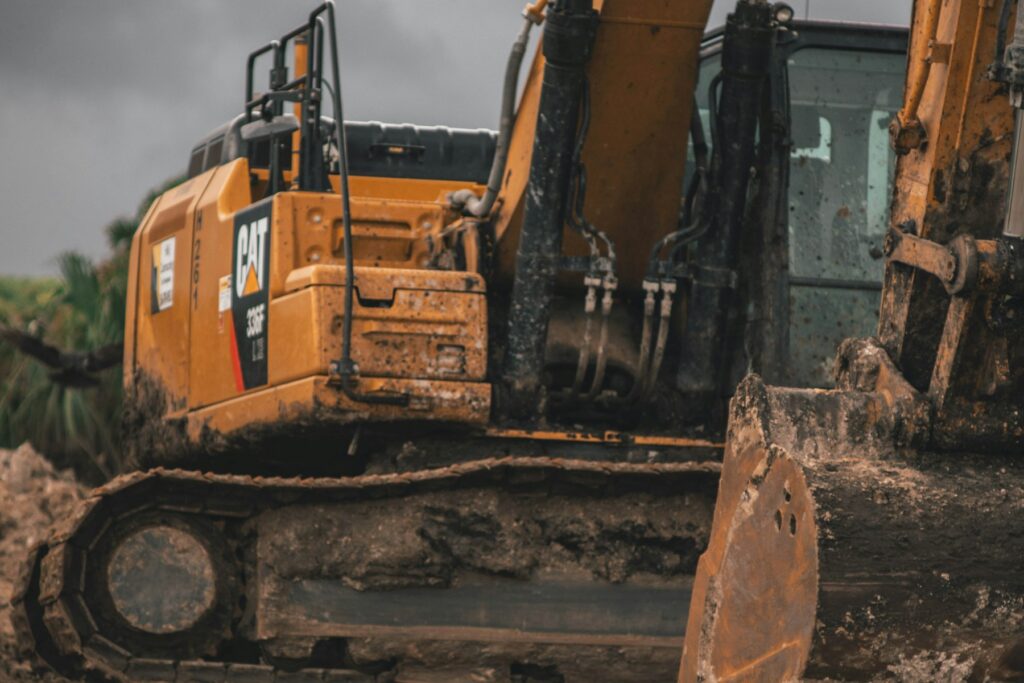
Heavy equipment fails in two ways, and they need different responses. Wear is the steady loss of material where steel meets dirt, rock and concrete — cutting edges, teeth, adapters, wear plate, bucket floors and side cutters. It is predictable, it is measurable, and it belongs in a maintenance schedule rather than an emergency call.
Fatigue and overload damage is the other kind: cracks at boom and stick weld toes, torn cylinder mounts, cracked bucket ears, split attachment plates. That damage is not on a schedule and it accelerates. A machine with a crack in a load-bearing structure should come out of service until someone competent has looked at it — those failures happen under load.
Because the rig comes to you, wear work can be booked for a rain day or a Friday afternoon while the machine is already stopped, and breakdown work does not need a lowboy before it can start. On most sites the repair is not the expensive part — the crew standing around the machine is.
How an on-site repair runs
Block or lower the attachment, isolate the machine, disconnect the battery, protect hoses and rods.
Gouge or cut out failed metal, clean to bright steel, drill crack ends and bevel the joint.
Ground clamped close to the weld, correct process and filler for the base metal and thickness.
Plate where the section was under-built, confirm fit and alignment, inspect, fire-watch, reconnect.
We work on construction sites, contractor yards, quarries, plant hire lots and dealer premises across Dallas, Fort Worth, Arlington, Irving, Grand Prairie, Plano, Frisco, Garland, Richardson, McKinney, Carrollton and the surrounding metroplex.
To get the most out of a visit, have three things ready: the machine make and model, photos of the damage, and somewhere the machine can be worked on safely — level ground, clear of traffic, away from fuel storage. If an attachment can be dropped off the machine before we arrive, a bucket or coupler job often takes noticeably less time. For fleet work, grouping several machines into one visit is more efficient than separate trips. There is more detail in our guide to heavy equipment repair in DFW.
Equipment repair covers machines and attachments — excavators, skid steers, loaders, dozers, buckets and couplers. If the item is a trailer, see maintenance and repair, which covers frames, couplers and spring hangers. For general breakages on site that are not machine-related, that is mobile welding. If you need a new attachment, guard or frame built rather than repaired, that is fabrication, and anything holding a building up is structural welding.
Yes, with the right precautions. The battery is disconnected, the ground clamp goes on the same component as the weld and as close to it as possible, and electronic control units are isolated according to the machine manufacturer’s service manual. The risk is welding current finding a path back through a pin, bearing or control circuit — done properly it never gets the chance.
In most cases yes, and it is a normal repair: the crack is gouged out, its ends drilled, the joint bevelled and welded to full depth, with a plate added where the section needs help. Take the machine out of service until it is assessed — boom cracks grow under load. Where a repair has to be to a specific code or inspected, that is confirmed before work starts. [VERIFY]
Not always. Adapters, wear plate, small cracks and hardfacing are routinely done with the bucket on. For a full cutting-edge replacement it is faster and better to drop the bucket off and lay it where it can be reached from every side — if you can uncouple it before we arrive, the job usually takes less time.
Hardfacing welds a layer of abrasion-resistant material onto a surface that will be worn away by rock, sand or concrete — bucket lips and corners, side cutters, auger flighting, mixer paddles, blade edges. It is worth doing on parts that wear by abrasion, and worth doing before the part is badly worn. It is not the answer for parts taking heavy impact, because the deposit is hard and comparatively brittle.
Partly. Welding the bore back up can be done in the field. Returning it to round and to size normally needs line boring, which means the machining equipment on site or the component brought in. A bore welded up but not re-machined will wear again, and faster — so the full job matters more than the quick one here.
Yes — contractor yards, plant hire lots, quarries and dealer premises are all normal locations. For fleets it pays to batch: wear items like edges, adapters and hardfacing are ideal to group into a single visit rather than calling separately for each machine.
Tell us what you need and we will come back with a straight answer and a fair price. Free, fast, no obligation.